skip to main |
skip to sidebar
Link courtesy of Endless Emendation:
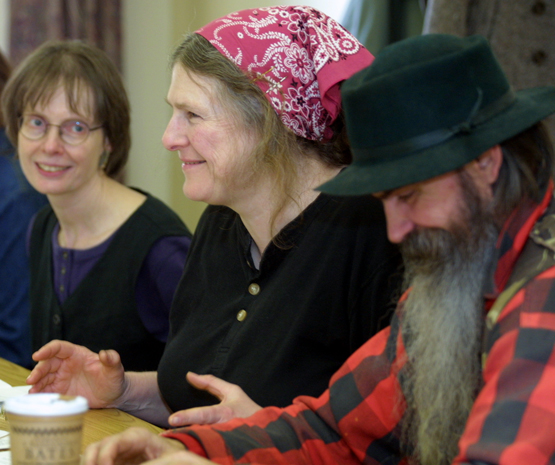
PARSONSFIELD, Me. — The novelist Carolyn Chute doesn’t have a working phone, a fax or a computer. She writes on a washtub-size electric typewriter that was probably state of the art in the ’70s. Ms. Chute (pronounced CHOOT) and her husband, Michael, live in a small compound at the end of an unpaved road in this rural Maine village near the New Hampshire border. There are stacks of old tires in the yard, a rusted bedstead, a pen full of Scottish terriers and an assortment of well-used vehicles. A bumper sticker on Mr. Chute’s pickup reads, “School Takes 13 Years Because That’s How Long It Takes to Break a Child’s Spirit.”
I admire the lifestyle. I don't know if I could do it myself, though. It's one thing to read about it, another entirely to do: what would I do without the computer?
Finding new content and finding time to put it up or write something halfway clever has been difficult lately, as you all have no doubt noticed. I'm hoping to be back on the stick sometime soon.
 Boy. It's been a while. Sorry about that, all of you who keep faithfully coming back to check out the blank pages. I've been taking a class in poetry (going well, thanks for asking) teaching, dealing with the necessary complications of three children, deaths in the family, and so on.
I want to talk briefly about one of the main inspirations for beginning this blogazine. I've read many books written about rural America, and nearly every one exists in a political vacuum. I don't know if it's because rural folk, especially the rural poor, have been taken advantage of so many times that discussing politics seems only to fuel the fires of indignance and to reenforce the quasi-libertarian views many rural folk have, or what, but most of these books don't provide characters that look to the larger scheme of things. Rural folks are generally concerned with food, shelter and procreation and the work they do to provide those things , like everyone else. Maybe they can't spare a thought for the big picture because the big picture has traditionally never included them. They're engaged politically insofar as it affects them directly--local politics especially--but so deep in the day-to-day grind that the politics of the larger picture seems a luxury to be engaged in when everything else is taken care of, and 'everything else' is rarely taken care of completely. In my opinion, just to mention one big-picture item, most folks would buy local, avoid Wal-Mart, shun other big businesses for their daily needs, if they were given an opportunity to do so cheaply. Wal-Mart is cheap and accessible; ergo there's one near every community. There are many fewer local options now, and that lack forces the small-town inhabitant to travel to that ugly-ass strip mall and lay out the cash where they can make it work for them best.
The point is, Carolyn Chute, well-known writer and activist, does not shy away from politics. In her last book, Snow Man, she dove directly into controversial waters, and nearly drowned. Snow Man is about a member of a Maine militia, Robert Drummond, who has had enough--the 'why' of this becomes clear immediately-- and travels to Boston to assassinate some senators, succeeds in one attempt, and runs, wounded, bleeding and nearly passed out onto Beacon Hill and into the home of another senator. In the first nearly absurd moment of a book with plenty of absurd moments, the senator's daughter and wife hide him in a spare bedroom, while the whole world is looking for him. Given that premise, you might avoid the book, which would be amistake. Snow Man deals with politics in a way that might surprise you as it entertains you. Chute sees activism and support for at every angle, and breaks away from the main narrative to share the talk of people in bars and churches who support Drummond, much in the manner of a Greek chorus. I found myself nodding sympathetically and wincing somewhat at the sheer aggressive tone, not quite buuying the premise, but hooked nonetheless; I feel, in many ways, just like her people: fed up, pissed off, and ready to act.
Reviewers complained about cardboard characters, atypical politics, unwieldy plot, and the sheer anger of Chute and her stand-in Drummond. I found little of that to be accurate, even when I re-read it this week in the cold light of a few years perspective. It's first a good, entertaining book. While not a great book per se, it's also not an exegesis of the politics of militias and rural residents of Maine, as some have claimed. The book claims none of that: Drummond's heroes are Nestor Cerpa and Subcomandante Marcos, unlikely heroes for a rural, quasi-conservative guy from Maine. But that's the beauty of it. You can see the opposing forces of the book set up so clearly, and poor Drummond is doomed from the get-go. As literature, it probably fails, as polemic, it's wonderful to read.
Chute's new book is in my hands, The School on Heart's Content Road. She's been working on it for years, even as her literary reputation sunk a bit with the cool reception of Snow Man. I've been waiting for it, not because of The Beans of Egypt Maine, lovely book though it is. I've been waiting to see what's next for her because of Snow Man.
I hope you read one of her books; all of them deserve a wider audience.
Carolyn Chute's Wicked Good Militia
Audio interview with Don Swaim
Carolyn Chute Goes Back to Egypt Maine